Assessment and certificate
Can you explain it without AI? We assess whether you make your own decisions, verify AI-generated work and can explain your architecture — with criteria published before you start.
Nine ways we assess
Practical assignments
Weekly deliverables with published acceptance criteria.
Code review
Mentors review your pull requests for correctness, clarity and risk.
Architecture discussions
You explain and defend structural decisions at three points in the program.
Product demonstrations
You show what shipped, to your mentor and to real users.
Problem-solving challenges
Unseen problems solved live, so the approach is visible — not just the result.
Independent research tasks
You learn something unfamiliar and report what you found and how you verified it.
Oral explanations
Short, AI-free explanations of code and concepts, every week.
Portfolio assessment
Your repository, decision records and journal, reviewed as a whole.
Final project defense
A live presentation, demo and technical Q&A on your capstone.
The rubric
Used at the mid-program review and the final defense. Levels: Emerging → Developing → Proficient → Advanced. Below is what Proficient looks like.
| Dimension | Weight | Proficient means |
|---|---|---|
| Problem & user understanding | 20% | The problem is evidenced by research with real users, and product decisions trace back to it. |
| Engineering quality | 25% | The code is typed, tested and readable; the architecture fits the problem; security basics are in place. |
| AI judgement & verification | 20% | AI is used where it adds value; outputs are validated and evaluated; AI-generated code was reviewed, not trusted. |
| Independent reasoning & explanation | 20% | You explain architecture and code without AI, justify trade-offs and handle follow-up questions. |
| Validation & iteration | 15% | Real users tried the product; changes were made from evidence and measured honestly. |
To pass: a weighted average of at least 2.5 out of 4, no dimension below Developing, and at least Proficient in independent reasoning and explanation at the final defense.
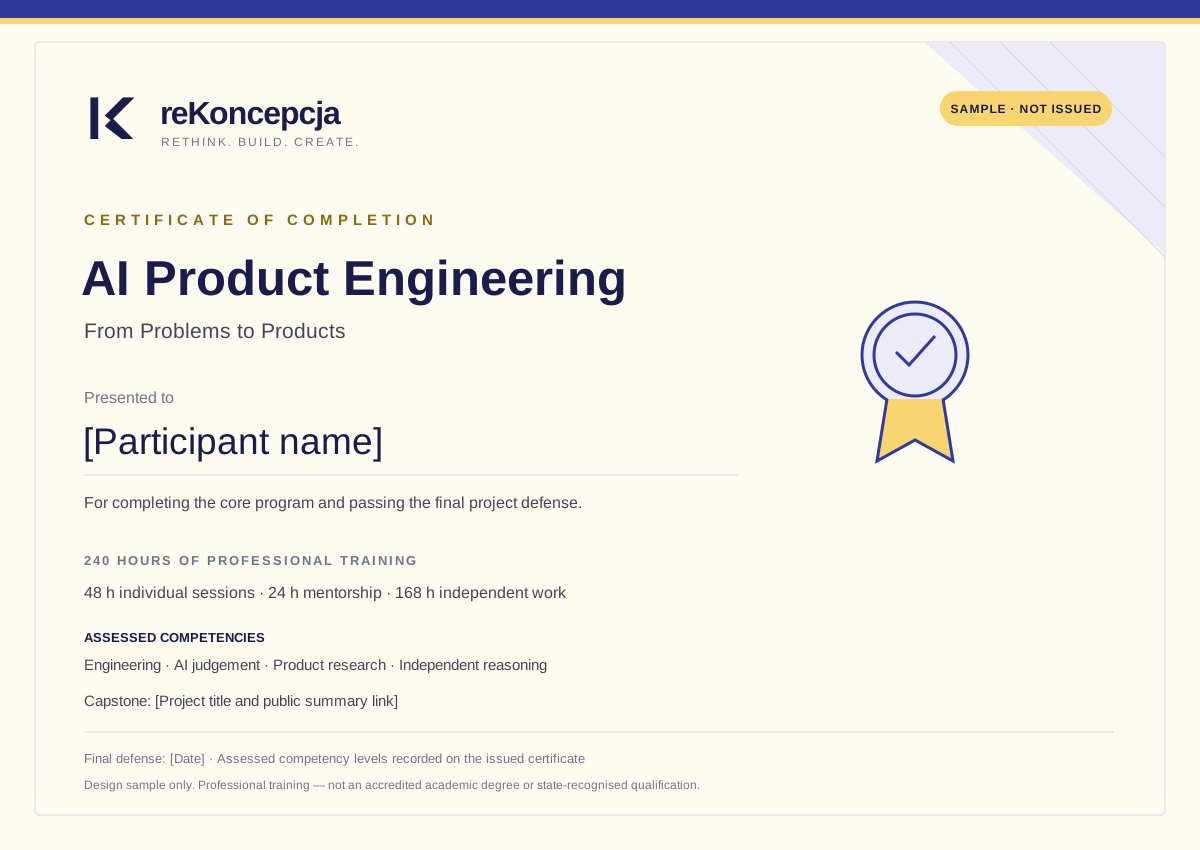
Certificate of Completion
Awarded when all of these are true (full course; the basic and extended courses end with their own final review).
- All core assignments completed and accepted
- Mid-program review passed in week 10
- A deployed capstone that meets the capstone requirements
- Final defense passed under the rubric
- Learning journal entries for at least 15 of the 20 weeks
- Attendance at no less than 80% of scheduled individual sessions (rescheduled sessions count)
What the certificate states
- Program title and total hours, broken down into one-to-one sessions, pair coding, mentorship and independent work
- Competencies assessed and the level reached
- Capstone project title and a link to its public summary
- Date of the final defense
A certificate of completion of professional training issued by the Foundation — not a state diploma.
Main program: project → assessment → certificate
Earn your certificate through assessed project work
In the full course you receive the certificate of completion after 33 accepted assignments, the review in week 10, the launch in week 18 and a passed defense in week 20. A learning journal and attendance under the criteria are also required. The basic and extended courses end with their own final review.
The document lists your hours, assessed competencies, project title and defense date.