Skip to content
reKoncepcjaRethink. Build. Create.

Professional education · new specialism

AI Product Engineering

In 5.5 months you learn to design, build, launch and sell AI products — from market analysis through code to first customers — working with practitioners on your own product. You finish with a new specialism: AI Product Engineer.

  • Online 1:1
  • 5.5 months
  • Instructor chat
  • Polish or English

Next starts · one-to-one sessions

Group training for companies is arranged separately.

5.5 months · €8,900 · 30 h/week

Applying takes 2 minutes. First a short call and diagnostic, then the agreement — there's no commitment when you apply.

What a week looks like
About 30 hours: 3 h of one-to-one sessions, 6 h of pair coding on your product and 6 h of mentorship at times agreed with you. The rest of the time you work at your own pace on recordings, assignments and your own product — with an instructor chat at hand.
Who it's for
For anyone who wants to build their own AI product — including from zero, with no programming experience. We set the pace in an entry diagnostic.

What you will learn

  • Run at least 5 problem interviews and map 5 existing alternatives — you build only on evidence (week 2)
  • Ship prototype v0.1 with an AI agent in week 3 and, by week 8, an app with accounts, PostgreSQL and regression tests (v0.5)
  • Add AI where it earns its place: a model API, RAG with citations and 30 questions to measure quality (weeks 9–11)
  • Keep AI cost in check: limits, timeouts, a safe fallback, cost and latency measurement (week 11)
  • Deploy with Docker, CI/CD and monitoring; rehearse a database restore and rollback (weeks 15–16)
  • Test positioning with 5 target users, set a price and model unit economics including AI costs (week 17)
  • Launch to real users and ship 2 improvements measured before and after (weeks 18–19)

Problems you will solve

  • How do you turn an idea into a product customers pay for?Interviews and evidence first, code second. By week 17 you have a price and an economics model grounded in customer conversations.
  • Where do you find first users — and how do you keep them after week one?One primary acquisition channel, a measured activation metric, onboarding with at least 3 new users and fixes driven by the funnel.
  • How do you build an AI product that answers from data instead of making things up?RAG with citations and a test set that includes unanswerable questions — you compare two configurations before users see them.
  • What if AI writes code I don't understand?You review and test every change. In week 10 and at the defense you explain the architecture and change code without AI.
  • What does AI cost per new customer?You measure response cost and latency, set limits and include AI and infrastructure in your unit economics.

Tools and technologies

Product and sales

  • Interviews · Jobs To Be Done
  • Positioning
  • Pricing and unit economics
  • PostHog
  • Figma

Code and data

  • TypeScript
  • Python
  • Next.js · React
  • PostgreSQL
  • Drizzle or Prisma
  • Vitest · Playwright

AI

  • Claude Code · Codex · Cursor
  • Anthropic / OpenAI API
  • Vercel AI SDK
  • RAG · pgvector
  • Promptfoo
  • Agents · MCP · LangGraph

Deployment

  • Docker
  • GitHub Actions
  • Sentry
  • OpenTelemetry
  • Stripe
  • n8n

Why this program

Knowing the tools isn’t the same as knowing what to build.

AI makes it easier to write code. It doesn’t tell you which problem is worth solving, whether anyone will pay for your solution, or whether the product is ready for real users.

So we bring product, engineering and sales together in one course. You learn to ask better questions, decide from data and build products that create real value — with an instructor and a mentor, not just another playlist.

  1. 1

    Start where you are

    An entry diagnostic and a plan shaped around you. You can start from zero — we set the pace together.

  2. 2

    Learn on a real product

    Your problem, your users and your code. You show the first version in week 3 and keep improving it until launch.

  3. 3

    Leave with more than a certificate

    A deployed product, a documented portfolio, assessed competencies and a plan for what comes next.

Before you start building

AI engineer or ML engineer?

ML engineer or AI engineer? A short comparison of both roles — it shows which skills you build on the course and where you will use them.

Who this is for

This fits you if

  • You want to build and sell your own AI product — even if you are starting from zero.
  • You have a startup idea and want to go from validation to first sales.
  • You want to upskill and build complete products with AI, not just use the tools.

Another option may suit you better if

  • You want to use AI tools rather than build products with them — this course goes much deeper.
  • You can't free up about 30 hours a week (about 6 h each weekday) for 20 weeks — join a later group.

Not sure? Book a consultation

Prerequisites

  • No programming experience required — you can start from zero. Taught in Polish or English. Entry diagnostic; 30 h per week (about 6 h each weekday).
  • A computer that can run Docker and a separate budget for AI tools, APIs and hosting — about USD 20–50 a month.

Professional education · new specialism

AI Product
Engineering

One real problem. One working product. A new way of building.

weeks
20
connected modules
12
hours with your instructors
300

Topics follow what your product needs next, not a lecture catalogue.

From problems to products

  1. Weeks 1–3

    Discover & validate

    Find a real problem, talk to customers and put a first prototype in front of them.

  2. Weeks 4–13

    Build & connect

    Full-stack foundations, real data and AI features where they add value.

  3. Weeks 14–20

    Launch & grow

    Deployment, pricing, first users and measurement — then you defend your decisions.

See the 12 modules

12 modules. One connected product.

The whole program step by step: why each module matters, what you will learn and what you will be able to do. Modules interleave across the 20-week route: you meet a topic once, then come back to it at later stages when your product needs it. Each module shows those weeks.

  1. Use AI as a learning companion without outsourcing your judgement.

    Why this module

    Tools will change many times in your career. The ability to learn a new one quickly — and to notice when an AI is confidently wrong — will not.

    What you will learn

    • How LLMs work
    • AI limitations and hallucinations
    • Prompt engineering
    • AI as a learning companion
    • Learning how to learn
    • Critical thinking
    • Research methodology
    • Knowledge management
    • Technical documentation
    • Problem decomposition
    • Independent verification

    What you will be able to do

    • Explain how an LLM produces output and why it can be confidently wrong
    • Verify AI claims against primary sources and keep an evidence log
    • Decompose an unfamiliar problem into learnable sub-problems
    • Run a personal knowledge system that outlives the program
  2. Find problems worth solving by understanding how people actually behave.

    Why this module

    Most products fail because they solve a problem nobody has badly enough. Discovery is the cheapest place to be wrong.

    What you will learn

    • Problem identification
    • User needs
    • Behavioural psychology foundations
    • User research
    • Customer interviews
    • Jobs To Be Done
    • Decision-making
    • Cognitive biases
    • Ethical product research
    • Problem validation

    What you will be able to do

    • Run unbiased interviews that focus on past behaviour
    • Express needs as Jobs To Be Done with measurable pains
    • Spot cognitive biases in your own research
    • Research ethically, with consent and data minimisation
  3. Direct AI coding agents like an engineer, not a passenger.

    Why this module

    AI agents can write a lot of code quickly. Whether that code helps or hurts depends on the specification, the context and the review you bring.

    What you will learn

    • AI coding agents
    • Claude Code
    • Codex
    • Cursor
    • IDE and CLI workflows
    • Context management
    • Project instructions
    • Specification-driven development
    • Git workflows
    • Code review
    • Debugging with AI
    • Engineering decision-making

    What you will be able to do

    • Drive coding agents from written specifications
    • Manage context with project instructions and well-scoped tasks
    • Review, test and reject AI-generated code — with reasons
    • Keep a Git history that tells the story of your decisions
  4. Understand the code you ship well enough to change it with confidence.

    Why this module

    Generating code is easy. Debugging, extending and securing it requires knowing how software actually works.

    What you will learn

    • Programming fundamentals
    • TypeScript
    • Python
    • APIs
    • HTTP
    • Databases
    • Git
    • Testing
    • Architecture
    • Design patterns
    • Software quality

    What you will be able to do

    • Read and explain TypeScript and Python code you did not write
    • Design and consume HTTP APIs correctly
    • Write tests that catch real regressions
    • Apply core design patterns — and recognise when not to
  5. Build a real multi-user web product, from database to interface.

    Why this module

    A product is more than a demo: it has accounts, data, permissions, files, jobs and — eventually — payments.

    What you will learn

    • React
    • Next.js
    • Backend architecture
    • PostgreSQL
    • Authentication
    • Authorization
    • File storage
    • Background jobs
    • SaaS architecture
    • Payments
    • Internationalization

    What you will be able to do

    • Build a Next.js app with a clear server/client boundary
    • Implement authentication and authorisation correctly
    • Model and query product data in PostgreSQL
    • Add files, background jobs, payments and i18n when the product needs them
  6. Integrate language models reliably, measurably and affordably.

    Why this module

    An AI feature that works in a demo and fails one time in ten in production is a liability. Engineering makes it dependable.

    What you will learn

    • LLM APIs
    • Structured outputs
    • Function calling
    • Embeddings
    • RAG
    • Vector databases
    • Document processing
    • Retrieval evaluation
    • Model selection
    • Cost optimization
    • AI reliability

    What you will be able to do

    • Integrate LLM APIs with validated structured outputs
    • Build and evaluate retrieval-augmented generation
    • Choose models by quality, latency and cost
    • Design for AI failure modes from the start
  7. Let software take multi-step actions — with humans firmly in control.

    Why this module

    Agents and automations act in the world. That makes permissions, approvals and observability engineering requirements, not extras.

    What you will learn

    • Agent architecture
    • Tool use
    • MCP
    • LangGraph
    • Agent orchestration
    • Human-in-the-loop
    • Workflow automation
    • n8n
    • External integrations
    • Permissions
    • Agent safety

    What you will be able to do

    • Design agents with explicit tools, limits and stop conditions
    • Expose and consume capabilities through MCP
    • Automate workflows with n8n and with code
    • Keep humans in control of consequential actions
  8. Make products people can use without an explanation.

    Why this module

    If users cannot find the value, it does not exist. Good design is how engineering effort reaches people.

    What you will learn

    • UX principles
    • Information architecture
    • User flows
    • Prototyping
    • Accessibility
    • Interface design
    • Usability testing
    • Design systems
    • Product feedback

    What you will be able to do

    • Map information architecture and critical user flows
    • Prototype and test with real users
    • Meet core accessibility requirements
    • Use a design system consistently
  9. Turn a useful product into a viable one.

    Why this module

    Engineers who understand pricing, positioning and unit economics make better technical decisions — and build things that last.

    What you will learn

    • Market research
    • Competitor analysis
    • Business models
    • Value proposition
    • Positioning
    • Pricing
    • Customer acquisition
    • Product analytics
    • Unit economics
    • MVP validation

    What you will be able to do

    • Analyse markets and alternatives with stated assumptions
    • Write a clear value proposition and positioning
    • Build a pricing hypothesis and unit-economics model
    • Define and instrument an activation metric
  10. Run software for strangers — reliably and affordably.

    Why this module

    Deployment is where a project becomes a product. Monitoring and cost control decide whether it stays one.

    What you will learn

    • Docker
    • CI/CD
    • Deployment
    • Cloud infrastructure
    • Monitoring
    • Logging
    • Performance
    • Scaling
    • Secrets management
    • Cost management

    What you will be able to do

    • Containerise and deploy reproducibly
    • Run CI/CD with tests and evals as gates
    • Monitor, log and respond to incidents
    • Manage secrets and running costs
  11. Earn the right to handle other people's data and decisions.

    Why this module

    AI adds new attack surfaces — prompt injection, data leakage, unsafe actions — on top of every classic one.

    What you will learn

    • OWASP
    • Secure coding
    • API security
    • Data privacy
    • GDPR foundations
    • Prompt injection
    • AI evaluation
    • Automated testing
    • Reliability
    • Responsible AI
    • Risk assessment

    What you will be able to do

    • Threat-model a product and fix critical risks
    • Defend against prompt injection and data leaks
    • Build automated tests and AI evaluations
    • Apply GDPR foundations and responsible-AI practice
  12. Launch, learn from real usage, and keep improving — the product and yourself.

    Why this module

    Launch is the beginning of learning, not the end of building. The same is true of this program.

    What you will learn

    • Product launch
    • User onboarding
    • Analytics
    • Customer feedback
    • Iteration
    • Documentation
    • Product presentation
    • Portfolio development
    • Long-term learning roadmap

    What you will be able to do

    • Launch to real users with an onboarding plan
    • Make decisions from analytics and feedback
    • Document and present a product convincingly
    • Plan your own next 12 months of learning

    Course finale

    Launch & Defense

    Launch to real users, improve from evidence, and defend your product and architecture.

How we teach

Three ways you work with your instructors

In the full course that's 300 h with your instructors. Each format has its own purpose — together they give you knowledge, working code and an understanding of it.

60 h

One-to-one sessions

3 h a week · live

New concepts and techniques, discussing your decisions and explaining code without AI.

120 h

Pair coding

6 h a week · live

We write your product's code for your problem together. The instructor explains every decision, and you learn to understand and change the code yourself.

120 h

Mentorship and reviews

6 h a week · live or async

Reviews of your pull requests, architecture and product, written feedback and a plan for the next week.

How you work on your product

Not a video library, but a repeatable cycle of building, feedback and understanding your own code.

  1. 1

    Brief and criteria

    Break the problem into a task with a measurable definition of done.

  2. 2

    Code and tests

    Work in a repository. AI assists, but you verify and explain the solution.

  3. 3

    Mentor review

    Discuss your pull request, architecture and risks. Record decisions in your Learning Journal.

  4. 4

    Iterate and demonstrate

    Make improvements, demonstrate the result and plan the next step.

Sample course assignment

Example task: a source-grounded answer

Build an assistant that answers from documents and shows its sources.

  • The answer includes a source reference
  • Missing evidence leads to a safe refusal
  • A test question set reveals errors and limitations
Review comment: add a test for a question the documents cannot answer. Explain when the system should refuse to answer.

Your week: 30 hours

About 6 hours each weekday. A steady rhythm of sessions; learning is mainly online, and in-person sessions are reserved for group training.

3 h

Interactive one-to-one sessions

Concepts, live building and AI-free explanations.

6 h

Pair coding on your product

We write your product's code for your problem together — and explain every decision.

6 h

Mentorship and reviews

Reviews of your code, architecture, product decisions and learning journal — live or async.

3 h

Lesson recordings

Watch at your own pace, before and after each session.

3 h

Materials and reading

Documentation, worked examples and exercises.

3.5 h

Practical assignments

The week's assignment, assessed against published criteria.

5.5 h

Project work

Your own work on the product: building, testing and launching it.

At every stage you have access to a chat with your instructors and to all course materials — recordings, documentation and examples. You don't wait for the next session when you get stuck — we answer in the chat within 1 working day. The materials stay with you after the course, with no time limit. For the ambitious: optional stretch tasks and extensions within the course. They never affect passing — take on as much as fits without overloading yourself.

Compare the three courses

The same weekly rhythm and the same support — what differs is the scope and what you finish with. You can start any course from zero.

Basic course · Essentials

AI Product Engineering Essentials

€4,450/ PLN 19,450

2 months · 240 h

3 h one-to-one, 6 h pair coding and 6 h mentorship each week

Who it's for
You want to check quickly whether an idea has a market before investing in building it.
You finish with
An AI prototype, a landing page and demand evidence — or proof the idea needs to change.
Product and sales
Customer interviews, value proposition, an offer test on a landing page.
Engineering and AI
A one-scenario prototype: interface, model API, basic response checks.
How it ends
Demonstration and final review in week 8.

Moving up: within 6 months of finishing Essentials you can join the full course and pay only the difference — €4,450 / PLN 19,450.

Professional education · new specialism

AI Product Engineering

€8,900/ PLN 38,900

5.5 months · 600 h

3 h one-to-one, 6 h pair coding and 6 h mentorship each week

Who it's for
You want a new specialism and the whole route: from problem to sales.
You finish with
A deployed AI product with first users, pricing, positioning and a sales plan.
Product and sales
Validation, positioning, pricing, unit economics, an acquisition channel, activation.
Engineering and AI
A full application: accounts, database, RAG, tests, CI/CD, monitoring, payments.
How it ends
Review in week 10, launch in week 18, defense in week 20.

Moving up: within 6 months of your defense you can add Advanced weeks 21–30 for the price difference — €5,000 / PLN 21,850.

Extended course · Advanced

AI Product Engineering Advanced

€13,900/ PLN 60,750

7 months · 900 h

3 h one-to-one, 6 h pair coding and 6 h mentorship each week

Who it's for
You want the full program, then to grow the product after launch: growth, costs and scale.
You finish with
Everything in the full course, plus growth metrics, unit economics and evidence of quality, security and reliability.
Product and sales
Plus: retention and cohorts, a second acquisition channel, LTV/CAC, a growth experiment.
Engineering and AI
Plus: model comparison, AI regressions, threat model, security and load tests, disaster recovery.
How it ends
Defense in week 20 and the Advanced final review in week 30.

The Twój StartUp 10% discount applies only to the full course: €8,010 (PLN 35,010) after eligibility is confirmed. You receive the certificate after passing your course's final review. Terms →


People discussing work on a laptop
Colleagues working together

300 h

full course · with instructors: one-to-one, pair coding, mentorship

Real learning needs real people

Not another platform.
People in your corner.

An AI tutor can help you practise. A human practitioner challenges your decisions, notices your progress and helps you get unstuck.

One-to-one teaching + mentorship: basic course 120 h, full course 300 h, extended course 450 h. Plus an instructor chat at every stage.

Enrol or book a call
Learn together, every week

Your engineer-instructor

One-to-one sessions and pair coding with a practitioner. You write your product's code together, ask the awkward questions and learn to explain your own code — without AI answering for you.

60 h one-to-one and 120 h pair coding

Someone who follows your progress

Your mentor & code reviewer

Feedback on your pull requests, architecture and learning journal. A person who sees where you’re stuck and helps adjust your route.

120 hours of mentorship & review

A fresh pair of eyes on the problem

Your product mentor

Seven times during the course they review your research, UX and business model, and you make corrections. At the end they run the final exam. They make sure the product is getting better — not just the code getting longer.

7 reviews with corrections and a final exam

Enrolment

Enrol on the course

How enrolment works

  1. Send the application form
  2. A short call and entry diagnostic
  3. Choose the course — basic, full or extended — and sign the agreement

Advice before enrolling

On the call we learn your goal and experience — including if you are starting from zero — and match the course and pace. Classes are taught in Polish or English, mainly online.

Twój StartUp discount

Confirmed beneficiaries receive 10% off the full course: €8,900 → €8,010 (PLN 38,900 → PLN 35,010). Status is confirmed before the agreement.

Apply online

On the application page, in a few minutes:

  • choose a program and start date (with the end date),
  • see the full training offer: hours, format, language, gross price and certificate,
  • send your application — also if a company pays or you're applying for co-financing.
Go to the application →

For organisations · separate service

Build your team’s capability.
Not just its tool stack.

Turn a real business challenge into a learning project. Your people learn to build, evaluate and operate AI-powered products — with practitioner guidance, on the scope of the full course.

Your context. Shared progress.

  • For two or more people from your company
  • Projects built around your business problems
  • Full-course scope and individually agreed assessment
  • A proposal and invoice for your organisation

Scope, support hours, schedule and price are tailored to your team.

Main program: project → assessment → certificate

Earn your certificate through assessed project work

In the full course you receive the certificate of completion after 33 accepted assignments, the review in week 10, the launch in week 18 and a passed defense in week 20. A learning journal and attendance under the criteria are also required. The basic and extended courses end with their own final review.

The document lists your hours, assessed competencies, project title and defense date.
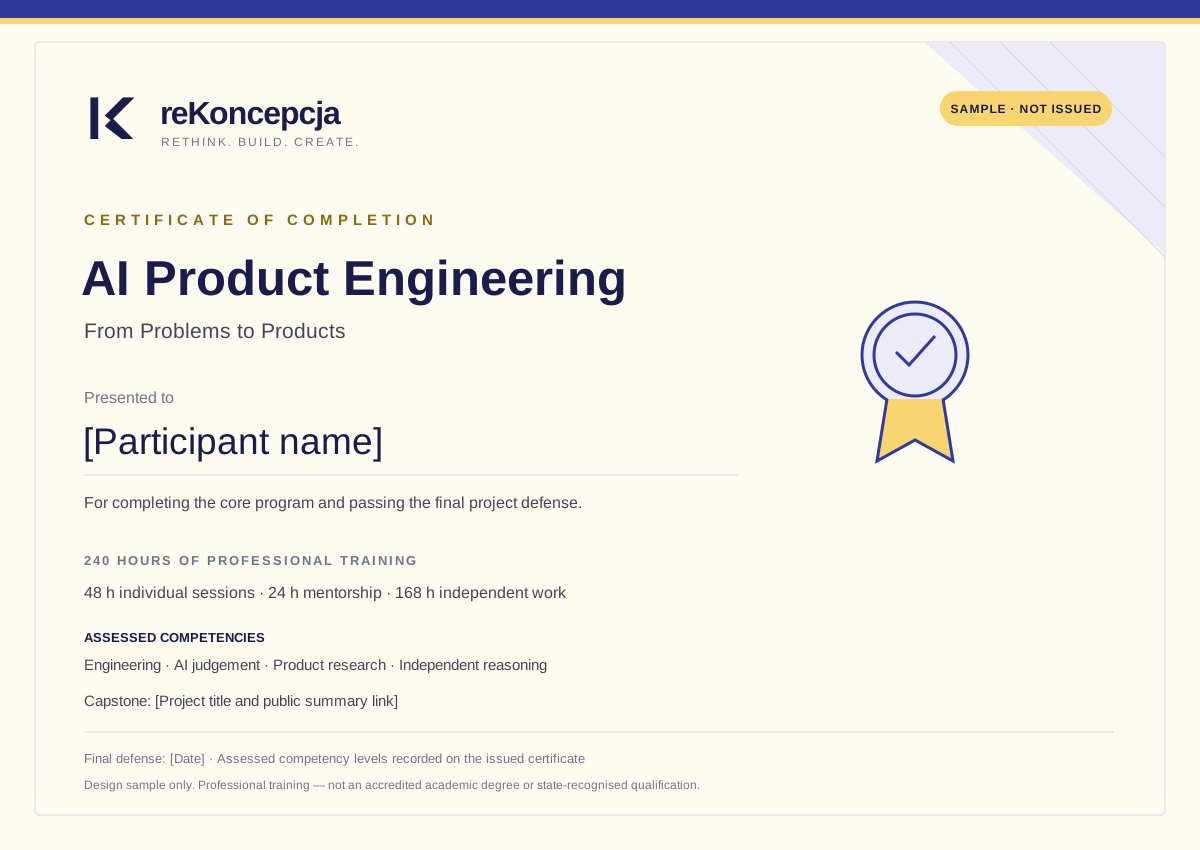
reKoncepcja certificate of completion sample

A little clarity

Good questions.
Honest answers.

Choosing a course is a real commitment. Here are a few things worth knowing first.

All frequently asked questions
Which course should I choose?

The basic course (2 months) if you want to test an idea fast: customer conversations, an AI prototype and a demand test. The full course (5.5 months) if you want the whole route from a problem through a product to first sales. The extended course (7 months) if you want to go further: growth, AI costs, security and scale. You can also start with the basic course and move up later, paying only the price difference. You don't have to decide alone — we'll match the course on a call before you enrol.

Do I need to know how to code?

No. You can start any of the three courses from zero — you write code with an AI assistant, and we teach you to read, check and explain it. We set the pace in the entry diagnostic: starting from zero, more time goes to the basics; if you already code, you move on faster to architecture and AI.

How much time does it take?

About 30 hours a week — roughly 6 hours each weekday. The full course is 20 programme weeks in 5.5 months — the 4 spare weeks cover holidays, illness, rescheduled sessions and support after launch. Every week includes 3 h of one-to-one sessions, 6 h of pair coding on your product and 6 h of mentorship; the rest is recordings, materials, assignments and work on your own product. Optional stretch tasks are there for the ambitious — they never affect passing.

How is this different from a bootcamp or an online course?

You don't build a tutorial project. You pick a real problem, test it with people and build your own product — learning each technology when your product needs it. Every week you work one-to-one with a practitioner, and you're assessed on your code, demos and a defense, not quizzes.

When and where are the sessions?

Online, at times agreed with you (CET/CEST): every week 3 h of one-to-one sessions, 6 h of pair coding and 6 h of mentorship — live and as code and product reviews. Between sessions you have an instructor chat and access to the materials. In-person sessions are only for team training.

What language is the program in?

Polish or English — you choose when you enrol.

Your next step starts with a conversation.

Tell us where you are — and what you want to build.

Find your learning route →